
Singapore has become the training ground for Southeast Asia’s next generation of blockchain developers, researchers, and enterprise architects. While other cities talk about Web3 potential, Singapore’s universities are already producing graduates who understand how distributed ledgers actually work at a fundamental level.
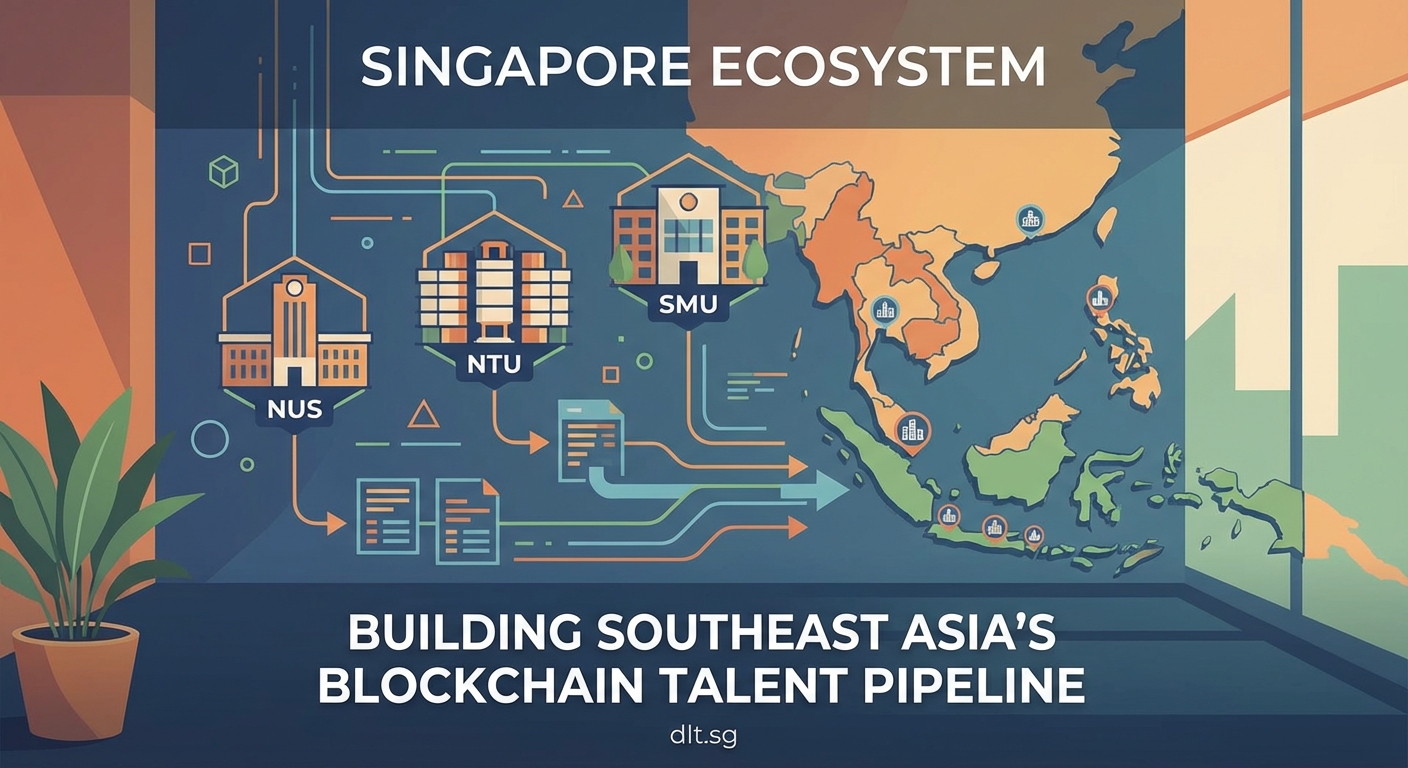
Singapore’s three major universities have established dedicated blockchain research centers, launched graduate programs, and partnered with leading protocols to create a comprehensive talent pipeline. These institutions combine academic rigor with industry collaboration, producing professionals who can bridge the gap between blockchain theory and real-world implementation across finance, supply chain, and government applications throughout Southeast Asia.
National University of Singapore Sets the Research Standard
NUS established the National Blockchain Research Centre in 2018, making it one of the earliest academic institutions in Asia to commit serious resources to distributed ledger technology. The center doesn’t just teach blockchain concepts. It actively develops new protocols and solutions.
The research lab that created Zilliqa, a high-throughput blockchain platform, emerged from NUS. That same team later contributed to Kyber Network. These aren’t just academic exercises. They’re production systems handling real value and real users.
The center focuses on three core areas:
- Scalability solutions for public blockchains
- Privacy-preserving smart contract architectures
- Cross-border payment infrastructure
Graduate students work alongside industry partners on funded research projects. This means they’re solving actual problems, not hypothetical case studies. A master’s student might spend six months optimizing consensus mechanisms for a financial institution’s private network.
NUS also runs a blockchain accelerator program that pairs technical talent with entrepreneurial students. Teams get access to lab resources, mentorship from protocol developers, and connections to Singapore’s venture capital community.
The university’s computer science department now offers a specialized track in distributed systems and cryptography. Students learn the mathematical foundations before they write their first smart contract. This bottom-up approach produces engineers who can audit code, identify vulnerabilities, and architect systems that won’t collapse under production load.
Nanyang Technological University Builds Industry Partnerships
NTU took a different approach. Rather than building everything in-house, they formed strategic partnerships with leading blockchain foundations and enterprises.
The Algorand Centre of Excellence at NTU represents a $50 million commitment to blockchain education and research. The partnership gives students access to Algorand’s development tools, testnet infrastructure, and core engineering team. Graduate researchers work on problems like state proof verification and quantum-resistant cryptography.
But NTU didn’t stop there. They launched a collaboration with Zero Gravity focused on decentralized AI systems. The $3.84 million research hub explores how blockchain can create transparent, verifiable AI training processes. Students learn to build systems where model training can be audited and verified on-chain.
These partnerships create a direct pipeline from classroom to industry. Top performers often receive job offers before they graduate. Companies get developers who already understand their technology stack and business requirements.
NTU’s approach to enterprise blockchain governance training stands out. They don’t just teach students how to write smart contracts. They teach them how to design governance frameworks for multi-stakeholder networks.
The university also runs executive education programs for working professionals. A bank’s technology team might spend a week at NTU learning how to evaluate blockchain use cases and build business cases for distributed ledger projects.
Singapore Management University Focuses on Business Applications
SMU recognized early that blockchain needs more than just engineers. The technology requires business analysts who understand tokenomics, compliance officers who can navigate Singapore’s payment services regulations, and project managers who can coordinate cross-functional blockchain implementations.
Their Master of Science in Innovation program includes a blockchain specialization that combines technical training with business strategy. Students learn Solidity and smart contract development, but they also study regulatory frameworks, token economics, and change management.
SMU’s research center focuses on practical applications in finance and supply chain. One recent project examined how real-world asset tokenization could improve liquidity in Singapore’s commercial real estate market.
The university maintains close relationships with the Monetary Authority of Singapore. Students get firsthand exposure to how regulators think about digital assets, decentralized finance, and systemic risk. This regulatory literacy makes SMU graduates particularly valuable to financial institutions navigating the compliance landscape.
SMU also runs a blockchain law and policy research group. They examine questions like how smart contracts fit into existing contract law, whether decentralized autonomous organizations can be legal entities, and how cross-border blockchain transactions should be taxed.
How Singapore’s Universities Structure Blockchain Education
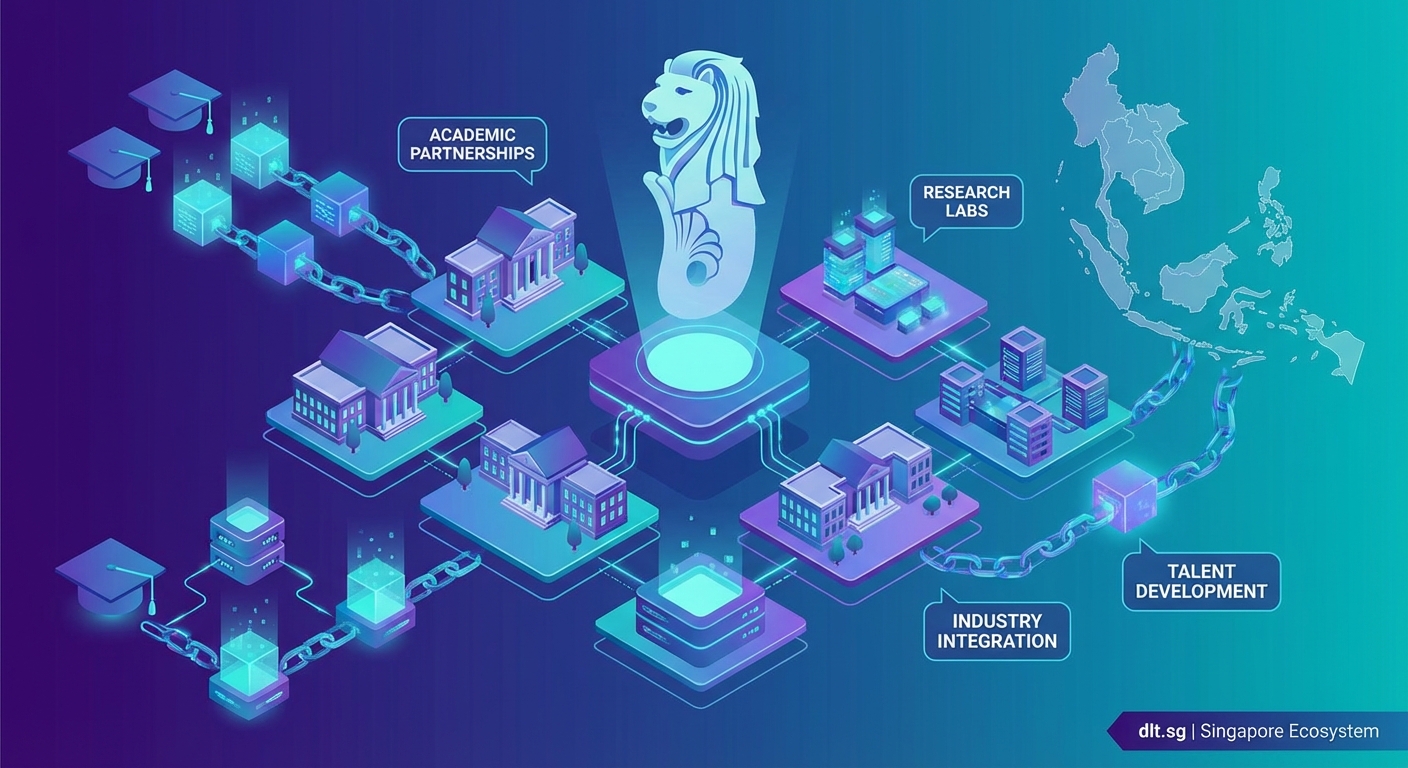
The three universities have developed complementary approaches that together create a comprehensive talent ecosystem. Here’s how they typically structure their programs:
- Foundation courses covering cryptographic primitives, distributed systems theory, and basic blockchain architecture
- Specialized tracks in either protocol development, application development, or business strategy
- Capstone projects completed in partnership with industry sponsors
- Research opportunities through funded labs and centers of excellence
- Professional development including hackathons, conferences, and industry networking events
Students don’t just learn one blockchain platform. They study multiple architectures to understand the tradeoffs between public and private blockchains.
A typical graduate program includes hands-on work with Ethereum, Hyperledger Fabric, Algorand, and at least one other platform. Students learn when to use each architecture and how to evaluate new protocols.
Curriculum Design That Bridges Theory and Practice
Singapore’s blockchain programs avoid a common trap. They don’t just teach students how to use existing tools. They teach the underlying principles so graduates can adapt as the technology changes.
Here’s what that looks like in practice:
| Learning Objective | Academic Component | Practical Application |
|---|---|---|
| Smart contract security | Formal verification methods, game theory | Auditing production contracts for vulnerabilities |
| Scalability solutions | Distributed systems theory, cryptographic proofs | Implementing layer 2 rollups or state channels |
| Tokenomics design | Mechanism design, behavioral economics | Creating sustainable incentive structures |
| Regulatory compliance | Legal frameworks, policy analysis | Building compliant DeFi protocols |
| Enterprise integration | Systems architecture, API design | Connecting blockchain to legacy systems |
Students learn that integrating legacy systems with blockchain requires understanding both worlds. They study enterprise architecture patterns alongside blockchain consensus algorithms.
The programs also emphasize what doesn’t work. Students analyze failed DLT pilot projects to understand common mistakes and unrealistic expectations.
Research Output That Moves the Industry Forward
Singapore’s universities don’t just educate students. They produce research that advances the entire blockchain field.
Recent publications from these institutions have covered:
- Novel consensus mechanisms that reduce energy consumption without sacrificing security
- Privacy-preserving techniques for enterprise blockchains handling sensitive data
- Cross-chain interoperability protocols that enable asset transfers between networks
- Formal verification tools that mathematically prove smart contract correctness
- Blockchain-based identity systems that give users control over their data
This research gets cited by protocol developers worldwide. It influences how new blockchains get designed and how existing systems get improved.
The universities also contribute to open-source projects. Faculty and students maintain blockchain tools, libraries, and frameworks used by developers across Southeast Asia.
“We’re not training people to use today’s blockchain technology. We’re training people to build tomorrow’s blockchain technology. That requires deep understanding of fundamentals, not just familiarity with current tools.” – Professor leading blockchain research at a Singapore university
Industry Collaboration Creates Real-World Learning
Every major blockchain program in Singapore includes substantial industry involvement. This isn’t optional. It’s built into the curriculum.
Companies sponsor research projects, provide internship opportunities, and send engineers to teach specialized topics. Students get exposure to production systems and real business constraints.
For example, a student might work on optimizing gas costs for smart contracts as part of a project sponsored by a decentralized exchange. They learn the theory in class, then apply it to code that will handle millions in daily trading volume.
Banks working on blockchain pilot programs often partner with university labs for technical expertise. This creates a feedback loop where academic research addresses industry problems, and industry validates academic solutions.
The collaboration extends beyond Singapore. Universities maintain partnerships with blockchain companies across Southeast Asia, creating opportunities for students to work on regional projects.
Preparing Students for the Full Blockchain Career Spectrum
Singapore’s blockchain education ecosystem recognizes that the industry needs diverse skill sets. Not everyone will become a protocol developer or cryptography researcher.
The programs prepare students for roles including:
- Smart contract developers who build decentralized applications
- Blockchain architects who design enterprise systems
- Security auditors who identify vulnerabilities
- Compliance specialists who navigate regulatory requirements
- Product managers who translate business needs into technical requirements
- Researchers who advance the theoretical foundations
Students can specialize based on their interests and background. Someone with a finance background might focus on DeFi protocols and tokenomics. An engineer might concentrate on layer 2 scaling solutions or zero-knowledge proofs.
The universities also recognize that blockchain careers often require understanding adjacent technologies. Programs include training in cloud infrastructure, DevOps practices, and cybersecurity fundamentals.
Common Mistakes Students Make and How Programs Address Them
Even talented students make predictable mistakes when learning blockchain development. Singapore’s programs have evolved to address these issues proactively.
Mistake 1: Focusing only on coding without understanding cryptographic foundations
Programs require courses in cryptography and security before students write production smart contracts. They learn why cryptographic hashing matters before they implement it.
Mistake 2: Assuming blockchain solves every problem
Students analyze use cases where blockchain added complexity without delivering value. They learn to evaluate whether distributed ledger technology actually fits a given problem.
Mistake 3: Ignoring gas costs and performance constraints
Programs emphasize optimization from day one. Students learn that elegant code that costs $100 per transaction won’t get used.
Mistake 4: Treating security as an afterthought
Security gets integrated throughout the curriculum. Students learn to think like attackers and understand common smart contract vulnerabilities.
Mistake 5: Neglecting regulatory and compliance considerations
Business and legal components ensure students understand that technical feasibility doesn’t equal market viability. They learn how DeFi protocols navigate compliance requirements.
The Regional Impact Beyond Singapore
Singapore’s universities serve as a talent hub for the entire Southeast Asian region. Students come from Indonesia, Malaysia, Thailand, Vietnam, and the Philippines. They return home with skills and networks that strengthen their local blockchain ecosystems.
The universities also run outreach programs and workshops across the region. Faculty travel to partner institutions to deliver training and establish collaborative research projects.
This regional approach recognizes that blockchain networks don’t respect borders. A supply chain solution for Singapore might extend to manufacturing in Vietnam and distribution in Indonesia. Students learn to think regionally from the start.
The programs also attract international students from beyond Southeast Asia, creating a truly global learning environment. Classroom discussions include perspectives from different regulatory environments, business cultures, and technological contexts.
Building Skills That Outlast Current Technology
Blockchain technology changes rapidly. The tools popular today might be obsolete in five years. Singapore’s programs focus on transferable skills that remain valuable regardless of which specific platforms dominate.
Students learn:
- How to evaluate new protocols and assess their technical claims
- How to read and understand academic papers on cryptography and distributed systems
- How to contribute to open-source projects and collaborate with remote teams
- How to communicate technical concepts to non-technical stakeholders
- How to stay current as the technology continues changing
This approach produces graduates who can adapt. When a new consensus mechanism gets proposed, they can read the whitepaper, understand the tradeoffs, and evaluate whether it delivers on its promises.
They understand that blockchain technology has evolved significantly since Bitcoin’s launch, and it will continue changing. Their education gives them the tools to evolve with it.
Where Singapore’s Blockchain Graduates Actually Work
The talent pipeline feeds multiple sectors. Financial services remains the largest employer, with banks, payment processors, and asset managers all building blockchain teams.
Technology companies hire graduates to work on infrastructure, developer tools, and enterprise solutions. Consulting firms need people who can advise clients on blockchain strategy and implementation.
Government agencies and regulators hire blockchain specialists to help craft policy and evaluate new technologies. They need people who understand both the technical details and the broader implications.
Startups across Southeast Asia recruit from Singapore’s programs. A decentralized finance protocol in Thailand or a supply chain platform in Indonesia might hire several graduates from the same cohort.
Some graduates launch their own ventures. The entrepreneurial ecosystem in Singapore provides funding, mentorship, and regulatory clarity for blockchain startups.
Measuring Success Beyond Job Placement
The universities track outcomes beyond simple employment rates. They measure impact through research citations, open-source contributions, patents filed, and companies founded.
They also track how graduates progress in their careers. Are they moving into leadership roles? Are they contributing to important projects? Are they advancing the field?
The programs regularly survey alumni to understand what skills proved most valuable and what gaps they discovered in their education. This feedback informs curriculum updates and ensures the programs stay relevant.
Industry partners provide input on graduate readiness. Do new hires require extensive onboarding, or can they contribute immediately? What skills are in highest demand? What emerging areas need more coverage?
Training the Trainers Who Will Scale Blockchain Education
Singapore’s programs also produce the next generation of blockchain educators. Doctoral students and postdoctoral researchers go on to establish programs at universities across Southeast Asia.
This multiplier effect extends Singapore’s impact far beyond its own graduates. A PhD student who studied blockchain scalability at NUS might return to a university in Vietnam and establish a similar program there.
The universities share curriculum materials, teaching resources, and best practices with partner institutions. They run faculty development programs to help professors at other universities build blockchain courses.
This collaborative approach recognizes that Southeast Asia needs far more blockchain talent than Singapore alone can produce. Building education capacity across the region benefits everyone.
Where Singapore Blockchain Education Heads Next
The universities continue evolving their programs to address emerging needs. Current focus areas include:
- Quantum-resistant cryptography as quantum computing advances
- Blockchain integration with artificial intelligence and machine learning
- Sustainability and energy efficiency in blockchain systems
- Central bank digital currencies and their implications
- Decentralized identity and privacy-preserving technologies
They’re also expanding executive education for working professionals who need to understand blockchain without becoming full-time developers. A compliance officer or product manager might take a short intensive course rather than a full degree program.
The programs increasingly emphasize interdisciplinary collaboration. Blockchain projects often require expertise in law, economics, computer science, and domain-specific knowledge. Universities create opportunities for students from different disciplines to work together.
Building Southeast Asia’s Blockchain Future Today
Singapore’s universities aren’t just responding to industry demand for blockchain talent. They’re actively shaping what that talent looks like and what it can accomplish.
By combining rigorous academic foundations with practical industry experience, these programs produce graduates who can both build current systems and imagine future ones. They understand the technology deeply enough to innovate, not just implement.
For prospective students, these programs offer a clear path into blockchain careers. For employers, they provide access to well-trained talent. For Southeast Asia, they represent a strategic investment in technological leadership.
The blockchain talent pipeline flowing out of Singapore’s universities will influence how the technology develops and gets deployed across the region for years to come. That pipeline keeps growing, keeps improving, and keeps producing the people who will build Southeast Asia’s decentralized future.